
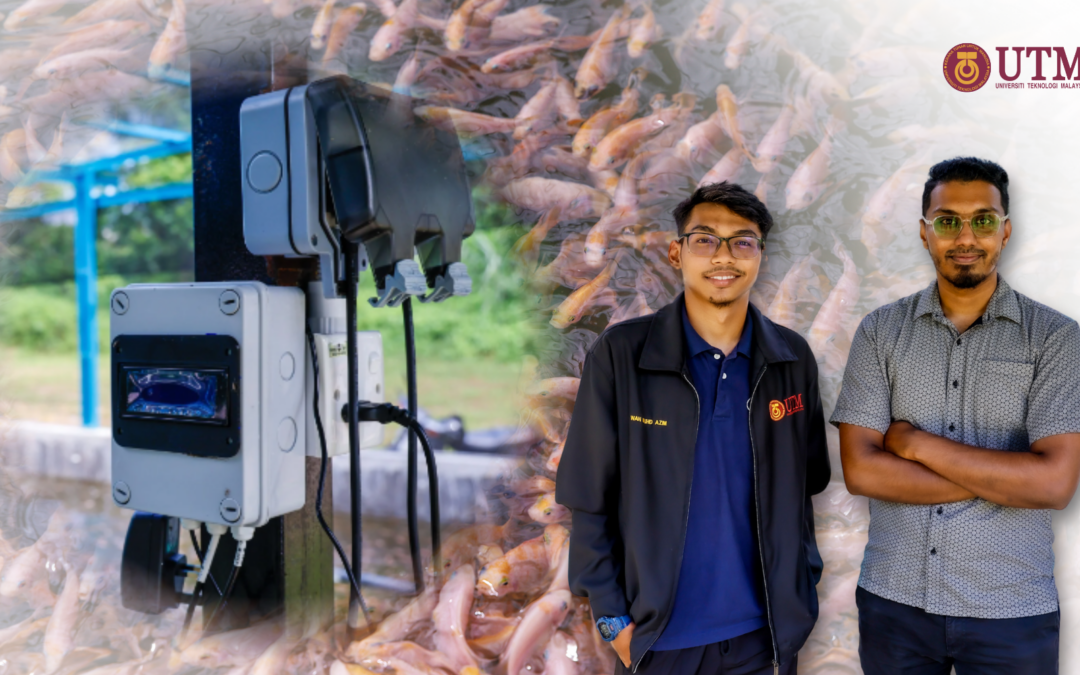
Starting from a small initiative to help the outside community, now a startup founded by Universiti Teknologi Malaysia (UTM) students, AquaTech Enterprise, has taken steps to become a leader in Internet of Things (IoT) technology in the field of aquaculture.
Wan Muhammad Azim Wan Mohamad Zaharuddin, a third-year Electrical Engineering student from the Faculty of Electrical Engineering, said the initial idea for AquaTech was sparked when he saw the urgent need among fish farmers for a smart monitoring system that could drastically reduce the risk of fish mortality.
“This project was first established around mid-2024, when we were involved with a community grant under the supervision of Dr. Adib. He introduced us to the farming community who were in dire need of technology to maintain the quality of pond water,” explained Azim.
Through close collaboration with Dr. Mohd. Adib Sarijari and Ts. Dr. Nor Aishah Muhammad from the Faculty of Electrical Engineering, AquaTech has developed two main products, the Water Monitoring System and the Pump Management System. This smart monitoring system is capable of recording oxygen, pH, and water temperature readings live, while the pump is designed to operate non-stop for 24 hours, complete with automatic alarms in the event of a power outage or malfunction.
“Imagine the pump suddenly dies, and fish start dying in large numbers. Our system works like a ‘pond guard’ – controlling, providing information and sending notifications to farmers,” added Azim.
Time challenges and a spirit of collaboration
What is more interesting is that AquaTech is not just the work of engineering students. Behind the software, sensors and electronic wires, there is also the management competence supported by Sri Prasaad A/L Srighanesan, a part-time student in Business Administration and a full-time Research Assistant at UTM’s telecommunications laboratory.
According to him, the time challenge was the main obstacle. However, the challenge was successfully overcome through a systematic division of work between team members. This combination not only ensured that the project ran smoothly, but also taught them the true efficiency of managing a small organization.
“We rotated between weekdays and weekends. I would manage on weekdays, while Azim would go to the field on weekends. We always ensured that our objectives would not be disrupted,” said Prasaad.
More interestingly, the development of AquaTech is also supported by various parties through funding and training, including the Malaysian Technology Development Corporation (MTDC), the Centre for Student Innovation and Technology Entrepreneurship (UTM XCITE), the Centre for Innovation and Commercialisation (ICC), and the Centre for Community & Industry Networking (CCIN). Sensor components are imported from China to ensure cost-effectiveness, while the installation and tuning of the system is done independently by the team.
“UTM is not just a campus, it is an innovation ecosystem,” said Prasaad. “Whenever we receive funding, we continue with our product evaluation, target small markets, provide free trials to farmers, and now we have marketed 15 IoT units throughout Johor including Mersing, Pagoh, Felda Linggiu and Felda Bukit Ramun.”
User support is also strengthened through continuous monitoring in the field and direct communication via the Telegram application to ensure that every farmer always gets the latest information.
Knowledge and innovation for the community
According to Ts. Dr. Nor Aishah, initiatives like AquaTech show how university students can contribute to real development with a big impact. He also stated that supporting students like Azim and Prasaad not only empowers them in terms of skills, but also saves development costs that usually require external professional services.
“In fact, our students have extraordinary hidden potential. If given space and trust, they can not only help the community, but also train themselves to become more professional,” he said.
Moving to the next phase, AquaTech plans to integrate artificial intelligence (AI) technology into their system to visually detect pond conditions, including detection of invasions and deterioration of fish health.
“The best human beings are those who benefit other human beings.”
By adhering to this principle, Azim calls on other students to dare to step out of their comfort zones and use their existing knowledge to add value to society.
“The opportunities are actually all around us, we just need to dare to ask, go out and search, and use our knowledge to create solutions,” he said.
